

CXone ACD Integration with Verint WFM
Introduction
This document provides a comprehensive overview of the integration between NiCE ACD and Verint WFM(WFM).
The integration enables the transfer of historical interval data and real-time agent state data from NiCE CXone into Verint WFM.
This document also establishes clear ownership boundaries, data flow understanding, and operational responsibilities across NiCE, Verint, and the Customer.
Scope of integration
In scope
-
Extraction of interaction and agent data from NiCE CXone ACD.
-
Data transformation and normalization into Verint-compatible formats.
-
Data delivery to Verint WFM ingestion endpoints.
-
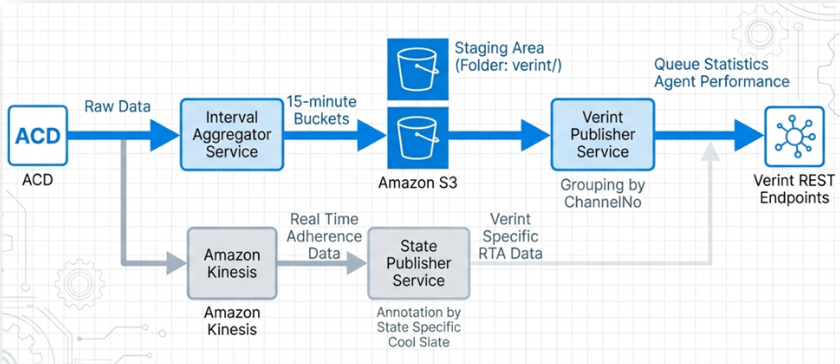
Historical data for queue metrics aggregated at a 15 minute interval cycle.
-
Historical data for agent metrics aggregated at 24 hours interval cycle.
-
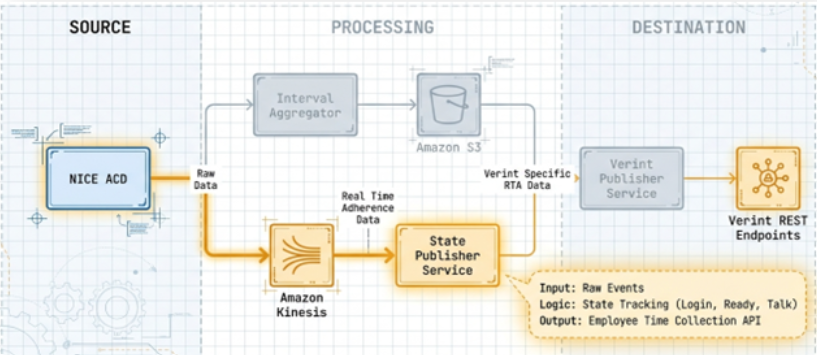
Real-time data for agent states.
Out of scope
-
Workforce policy configuration (for example: shrinkage rules, adherence logic, and Verint-side planning rules).
-
Custom reporting within Verint WFM.
-
ACD configuration changes unrelated to the integration itself.
-
Outbound dialer channel events, some deferrable/digital channel cases, and advanced routing scenarios with partial or no support.
-
No support for custom/granular agent states.
-
Automatic reload of missing data.
Responsibility & Ownership Model
System of record
| Date Domain | system of record | owner |
|---|---|---|
| Interaction Events | NiCE | NiCE |
| Agent State | NiCE | NiCE |
| Forecast | Verint WFM | Verint |
| Scheduling | Verint WFM | Verint |
| Adherence | Verint WFM | Verint |
Responsibility Boundary
NiCE is responsible for:
-
ACD data generation.
-
Data extraction, aggregation, transformation, and delivery to Version v1.0.
-
Verint APIs (Agent performance, Queue performance, Employee time collection).
-
Integration configuration and per-tenant linkage.
-
Providing CXone ACD Agent State to Outstate Mapping.
Verint is responsible for:
-
Data ingestion into WFM.
-
Metric calculations and aggregation inside Verint WFM (if applicable).
-
Forecasting, scheduling, intraday management, and adherence logic.
-
Agent State mapping (as per NiCE documentation) on Verint (if required).
Customer is responsible for:
-
Providing WFM system details such as client ID, client secret, data source IDs, and root URLs, access to the APIs.
-
Ensuring network connectivity between Verint WFM and NiCE ACD integration services.
-
Assigning a technical point of contact and coordinating validation activities.
-
Business rule validation and data reconciliation oversight.
Once data is successfully delivered to Verint, downstream processing and reporting are owned by Verint WFM.
Solution Overview
Architecture Summary
The solution follows a decoupled integration model:
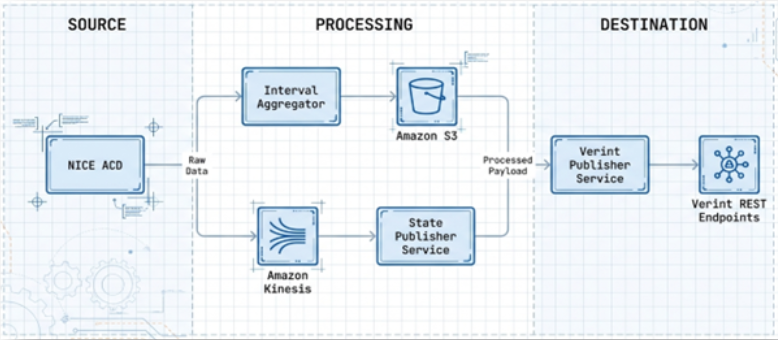
NiCE CXone (ACD + Integration Layer)
Source of contact events and agent activity/state data. CXone WFM Hub aggregates data, and the Verint Publisher transforms and delivers it downstream.
Verint WFM
Workforce analytics, forecasting, scheduling, intraday management, and adherence platform consuming the delivered data.
High-Level data flow
-
Interaction and agent activity events are generated in NiCE CXone ACD.
-
Data is aggregated by CXone WFM Hub into interval, intraday, and real-time datasets.
-
The Verint Publisher processes, validates, and transforms the data into Verint event formats.
-
Transformed data is delivered to Verint ingestion and adherence endpoints.
-
Verint WFM processes and aggregates the data for workforce use cases.
-
The data delivery to Verint follows the event-based architecture.
Historical & Interval Data Flow
Real-time Agent state data Flow
Integration modes
|
mode |
description |
frequency |
|---|---|---|
| Historical / Intraday Interval Data | Queue-level and agent-level interval data used for forecasting, scheduling, and intraday management | 15-minute intervals for queue performance, 24-hour Agent performance |
| Real-Time | Agent state updates for adherence and intraday monitoring | Near real-time |
Data Entities & Mapping
|
NiCE CXone ACD |
Verint WFM |
notes |
|---|---|---|
| Skill | Group | A CXone skill maps to a Verint WFM Group. |
| Agent ID | Agent / Employee Identifier | Agent ID alignment is required for reporting and adherence. |
|
Contact ID |
Interaction Identifier |
Contact events are transformed into Verint event formats. |
|
Channel |
Channel |
Supported examples include Voice, Chat (includes SMS as well), Email & Digital |
Historical Metrics & Calculation Principles
Queue Performance Metrics
| Verint Metric | Verint Definition |
Mandatory |
ACD Definition / Formula/Notes | ||||||
|---|---|---|---|---|---|---|---|---|---|
| Interval Start Time | Start time of the interval being imported. |
Yes |
intervalStartDate | ||||||
| Interval Duration | The duration of the interval being imported for in minutes. Allowed values 15, 30,60 Minutes. |
Yes |
Difference between intervalStartDate, intervalEndDate. Only 15 minutes of data aggregation interval is supported. (As agreed with Verint during combined discovery) | ||||||
| Channel (channel) | Channel of the contact statistic (e.g. voice). |
Yes |
Supported examples include Voice, Chat (includes SMS ), Email & Digital | ||||||
| Queue / Group ID (statistics.groupId) | The group ID of an employee as mapped in the datasource. Must support maximum 255 characters. |
Yes |
SkillName | ||||||
|
Tasks (statistics.tasks) |
Total tasks received by or offered to a queue. To support proper forecasting and scheduling, it is important to account for all tasks that would be handled in the queue in an ideal environment, for this reason, abandons should be included. |
Yes |
This data value follows the rule “arrived InQueue during this interval” so if a contact enters the queue it will be aggregated for that skill/queue. |
||||||
|
Average Handle Time (statistics.averageHandleTime) |
The average time it takes to handle tasks completed in the interval. This is usually a calculation of adding Average Talk Time and Average Wrap (or After-Call Work) Time together. |
Yes |
AHT= (HandleTime + Work Time) / Total Handled if >0 1. HandleTime = Sum of (ActiveSeconds + HoldSeconds + ConferenceSeconds + PreviewSeconds) 2. If it is outbound contact, it will calculate only outbound handle time with same formula HandleTime = Sum of (ActiveSeconds(Outbound) + HoldSeconds(Outbound) + ConferenceSeconds(Outbound) + PreviewSeconds(Outbound)) |
||||||
|
Average Time of Abandon (statistics.averageTimeOfAbandon |
The average time in queue for abandoned tasks. |
No |
Not sent from NiCE CXone ACD to Verint. |
||||||
|
Abandons (statistics.abandons) |
Number of tasks that are abandoned before an agent within the queue answers the task. |
No |
AbandonedShort + AbandonedLong ; Must be configured in ACD during skill definition
|
||||||
|
Service Level (statistics.serviceLevel) |
This value is defined by the percentage of tasks that are answered within a certain time threshold that is set by the administrator of the center. This is a percentage achievement against threshold during the interval, for example, 90% in 10 seconds. |
no |
SvcLvlPct = (Contacts Answered Within SLA / Total Contacts) × 100 Where: SLA Threshold = Configured time limit (e.g., 20 seconds) Contacts Answered Within SLA = Count of contacts answered ≤ SLA threshold Total Contacts = Total inbound contacts received. The following setting in the Omnichannel Routing (ACD) skill definition must be configured as per business need.
|
||||||
|
Average Speed of Answer (statistics.averageSpeedOfAnswer |
The average wait time experienced by all tasks answered for the queue during the interval. |
No |
QueueDelayTime / (HandledShort + HandledLong) if > 0 |
||||||
|
Staffing (statistics.staffing) |
The total minutes that all agents are logged in during the interval for the queue divided by the length of the time interval. This yields an effective number of agents staffed averaged over the time interval. Typically this field is not reported correctly by many systems, especially when skill-based routing is used. The Staffing Calculator adapter might be a better alternative to provide this value in these cases where the definition does not match. |
No |
Not sent from NiCE CXone to Verint. |
||||||
|
Volume Handled (statistics.volumeHandled) |
In Performance Reports, the Actual SL and Actual AHT combined/aggregated values are based on Volume Handled values. Performance Statistics for ad hoc reports display Actual VH, as well as Actual SL and Actual AHT aggregated values based on Volume Handled. This statistic only has Actual data (no forecasted/required) and it is used for calculating weighted averages. When available, the software uses this value for calculating the Actual Service Level and Actual Activity Handling Time values. |
No |
Total Handled =HandledShort + HandledLong where ; HandledShort =Contacts Answered Within SLA HandledLong= Contacts Answered Outside SLA |
||||||
|
Backlog (statistics.backlog) |
Total number of deferred media tasks in a queue at the end of the interval. (That includes tasks that were read but not replied to or done.) IMPORTANT NOTE: This field is intended to represent the total number of tasks in that queue that have not been completed as of the end of the interval. |
No |
Backlog = Contacts that are still waiting in the queue at the end of the interval i.e. not answered and not abandoned yet |
||||||
|
Occupancy (statistics.occupancy) |
The percentage of time that employees actually spend handling contacts on this queue in this interval against the available or idle time. Sometimes referred to as "utilization" in source systems. |
No |
Not sent from NiCE CXone to Verint. |
||||||
|
|
|
|
|
||||||
Agent performance
| Verint Metric | Verint Definition |
Mandatory |
ACD Definition / Formula/Notes |
|---|---|---|---|
| Interval Start Time (intervalStartTime) | Start time of the interval being imported. | Yes | intervalStartDate |
| Interval Duration (intervalDuration) | The duration of the interval being imported for in minutes - options are 1440, 120, 60, 30, 15. | Yes | Difference between intervalStartDate, intervalEndDate. Only 1440 minutes of data aggregation is supported. As per Verint WFM requirement “Daily Agent performance metrics for multiple agents for a single day on a recurring (daily) basis need to be posted to the API”. |
| Channel (channel) | Channel of the agent statistic (i.e. voice, chat or email). Initial version only supports voice. | Yes | Supported examples include Voice, Chat (includes SMS), Email & Digital. |
| Agent ID (agentStatistics.agentId) | The agent ID of an employee as mapped in the data source. | Yes | AgentID |
| EDM ID (agentStatistics.edmId) | The Extensible Dimension Member (EDM) external ID is used to associate the incoming source measure value with a specific EDM in the warehouse. The external IDs are specified in the EDM and are associated with data sources. | No | Not sent from NiCE CXone to Verint. |
| Actual Tasks (agentStatistics.actualTasks) | The number of tasks that are queued or directed to this agent, whether answered or abandoned. | No | Not sent from NiCE CXone to Verint. |
| Total Tasks Handled (agentStatistics.totalTasksHandled) | The number of tasks answered by the agent. | No | The total number of contacts handled by the agent during the interval, summarized by channel. |
|
Talk Duration (agentStatistics.talkDuration) |
Total time in seconds spent by the agent for inbound tasks. Does not include HoldTime, AfterCallWorkTime, AuxTime, or AvailableTime. |
No |
The total time the agent spent actively handling contacts, excluding hold time, summarized by queue and channel. This includes active conversation time, conference time, and consult time, and covers both inbound and outbound contacts. |
| After Task Work Duration (agentStatistics.afterTaskWorkDuration) | Total time (in seconds) of after call work or wrap-up over all the agents. | No | The total after-call work time completed by the agent, summarized by channel. This includes after-call work for all calls, including both inbound and outbound contacts. |
| Hold Duration (agentStatistics.holdDuration) | Total time (in seconds) of all hold periods over all tasks. Can include time the ACD caller is on hold during warm transfers. | No | The total time contacts were placed on hold by the agent, summarized by channel. This includes hold time for all calls, including both inbound and outbound contacts. |
| Login Duration (agentStatistics.loginDuration) | Total time (in seconds) the agent was logged on to the ACD system. | No | The total time the agent was logged in during the interval. |
| Idle Duration (agentStatistics.idleDuration) | Total time (in seconds) the agent spent in an idle state (ready, waiting for a call). | No | The total time the agent was available, waiting, and ready to receive a call during the interval. |
| Not Ready Duration (agentStatistics.notReadyDuration) | Total time (in seconds) the agent spent in not-ready states. | No | The total time the agent was in a not-ready or unavailable state during the interval, excluding time classified as after-call work. |
| Aux In Duration (agentStatistics.auxInDuration) | Total time (in seconds) the agent spent in a not-ready state related to an outbound call. | No | Not sent from NiCE CXone to Verint. |
|
Aux Out Duration (agentStatistics.auxOutDuration) |
Total time (in seconds) the agent spent in a not-ready state related to an inbound Non-ACD call. |
No |
Not sent from NiCE CXone to Verint. |
|
Total Held Tasks (agentStatistics.totalHeldTasks) |
The number of tasks placed in the hold state. |
No |
Not sent from NiCE CXone to Verint. |
|
Total Refused Tasks (agentStatistics.totalRefusedTasks) |
The number of tasks returned to the queue. |
No |
Not sent from NiCE CXone to Verint. |
|
Total Tasks Abandoned (agentStatistics.totalTasksAbandoned) |
The number of tasks abandoned after being queued or directed to the agent. |
No |
Not sent from NiCE CXone to Verint. |
Employee time collection metrics (Real-time Agent state)
Verint Employee Time Collection API fields with the NiCE CXone agent state / out state mapping used for real-time integration
| Verint Metric | Verint Definition |
Mandatory |
ACD Definition / Formula/Notes |
|---|---|---|---|
| Event Type (eventType) | Defines the event type. STATE_CHANGE is the only current supported event type. | Yes | Hard coded to “STATE_CHANGE” |
| Agent ID (agentId) | The ID of the agent on the ACD, mapped to an agent in the datasource | Yes | CXone ACD Agent ID |
| Event Time (eventTime) | Event Date and Time including time zone offset (ISO 8601) | Yes | Agent state event timestamp |
| Event Reason (eventReason) | The reason for changing state, mapped to the activity in combination with eventMode | Yes | CXone Outstate / Reason Code |
| Event Mode (eventMode) | The state the agent has changed to, mapped to the activity in combination with eventReason | Yes | CXone Agent State |
| ACD Name (acdName) | (optional) Not used, this is reserved for future use | No | N/A |
CXone ACD agent state to outstate mapping reference
| Cxone Agent state (event Mode) | Verint Definition (event reason) |
mapping principle |
|---|---|---|
| LoggedOut (0) | 0 | Standard logged-out state. |
| Available (1) | 0 | Standard available / ready state. |
| Unavailable (2) | 0 | Unavailable state with no specific reason code. |
| Unavailable (2) | -9 PromisePending | Unavailable state mapped to PromisePending. |
| Unavailable (2) | -8 CallbackPending | Unavailable state mapped to CallbackPending. |
| Unavailable (2) | -7 TransferPending | Unavailable state mapped to TransferPending. |
|
Unavailable (2) |
-6 DialerPending |
Unavailable state mapped to DialerPending. |
|
Unavailable (2) |
-5 ConsultPending |
Unavailable state mapped to ConsultPending. |
|
Unavailable (2) |
-4 OutboundPending |
Unavailable state mapped to OutboundPending. |
|
Unavailable (2) |
-3 InboundPending |
Unavailable state mapped to InboundPending. |
|
Unavailable (2) |
-2 HeldPartyAbandoned |
Unavailable state mapped to HeldPartyAbandoned. |
|
Unavailable (2) |
-1 Refused |
Unavailable state mapped to Refused. |
|
Unavailable (2) |
> 0 Customer Configured (Break, Lunch, etc.) |
Unavailable state mapped to a customer-configured reason code. |
|
InboundContact (3) |
0 |
Standard inbound contact handling state. |
|
OutboundContact (4) |
0 |
Standard outbound contact handling state. |
|
InboundConsult (5) |
0 |
Standard inbound consult state. |
|
OutboundConsult (6) |
0 |
Standard outbound consult state. |
|
Dialer (7) |
0 |
Standard dialer state. |
|
Dialer (7) |
0 |
Dialer state mapped to a customer-configured reason code. |
|
Dialer (7) |
-13 PreviewNotification |
Dialer state mapped to PreviewNotification. |
|
Dialer (7) |
-6 DialerPending |
Dialer state mapped to DialerPending. |
|
Dialer (7) |
-4 OutboundPending |
Dialer state mapped to OutboundPending. |
|
LoggedIn (8) |
0 |
Standard logged-in state. |
Important considerations
Differences between NiCE and Verint reports may occur due to:
-
Interval alignment requirements (15-minute buckets must match on both sides)
-
Different downstream processing and aggregation inside Verint WFM after API delivery
-
Queue versus agent queue differences in some digital or multi-agent scenarios
-
The RTA integration enforces a maximum of 1,000 events per request and 60,000 events per hour within a sliding 60-minute window (Verint API imposed rate limit). Events are automatically batched before submission to Verint, and each batch is validated for structure and required fields prior to processing.
-
The RTA handling of delayed events is controlled through the allowPastEvents setting, which determines whether past events are accepted or rejected. This setting should be defined during implementation, as it affects whether the solution prioritizes real-time processing integrity or event reconciliation.
Time & Interval Standardization
-
Standard interval: 15 minutes
-
Time zone: UTC
-
Day boundary definition: The business day is defined using the tenant time zone configured in NiCE ACD. Once the final interval file for that local day is received, the system aggregates the full 24‑hour agent performance data and submits it to Verint, using the same boundary converted to UTC for processing.
Data Latency
| category | processing time |
|---|---|
| Historical Data | Delivered as interval data using configured 15-minute reporting intervals; Latency depends on the number of Queues and agent records available for aggregation. |
| Real-Time Adherence Data | Near real-time agent state delivery |
API Governance
-
The integration uses Verint-facing delivery APIs for historical/intraday and real-time adherence flows.
-
API error handling, retry policies, pagination, and throttling behavior are in place as per Verint documentation.
-
Monitoring and issue investigation are supported via CXone Services/Support workflows.
Security & Access Control
-
Secure credential handling is required for client ID, client secret, data source, and root URL configuration values.
-
Secrets are stored securely and APIs are internal to the CXone integration architecture.
-
Authentication uses vendor-provided credentials and endpoint access details supplied by the customer.
-
Role-based access requirements on the CXone side are identified as prerequisites for implementation.
Dispute handling
Limitations
-
One active WFM configuration per tenant / one active vendor per tenant
-
Outbound dialer and certain digital channels may have partial or no support
-
Some reporting differences may occur in queue versus agent queue statistics for digital multi-agent scenarios
-
Historical repost / backfill is supported through a manual support process and is intended to be rare.
-
Dependency on source and destination platform/API availability is implied by the integration architecture.
-
Agent performance aggregated at Channel & Agent (no categorization between inbound/outbound) for 24 hours. Limitation as per the Verint API restrictions.
Assumptions
-
Accurate ACD skill, queue, and agent configuration is required for correct mapping and delivery.
-
Consistent mapping across CXone and Verint is required for skills, agents, teams, intervals, and time zones.
-
Customer provides valid Verint credentials, endpoints, and data source information.
Change Management & Impact
| change | impact | action required |
|---|---|---|
| Skill changes | High | Update CXone skill to Verint queue mapping. |
| Agent ID changes | Critical | Re-align agent identifier mapping across systems. |
| Queue restructuring | High | Review queue/skill mapping and validate downstream workforce impact. |
| Interval length changes | High | High Ensure Verint interval configuration matches CXone interval generation. |
RACI Matrix
| Activity | NiCE (ACD + Integration) | Verint |
customer |
|---|---|---|---|
| Data Generation | R/A | I |
I |
| Data Extraction & Transformation | R/A | I |
I |
| Data Delivery to Verint | R/A | I |
I |
| Data Ingestion | I | R/A |
I |
|
Metric Calculation |
R/A |
C |
I |
|
Data Validation |
R |
I |
A/C |
|
Issue Resolution (Data Pipeline) |
R/A |
C |
C |
|
Issue Resolution (WFM Logic) |
C |
R/A |
C |
Legend:
-
Responsible (R): The person or team doing the actual work/tasks.
-
Accountable (A): The person who owns the outcome and approves the task; only one "A" per task.
-
Consulted (C): Subject matter experts or stakeholders whose input is needed before or during the work.
-
Informed (I): Those who need to be kept updated on progress or decisions after completion.
Support Model
| issue type | owner |
|---|---|
| ACD Data Issues | NiCE |
| Integration / Data Flow | NiCE |
| Verint Data Ingestion | Verint |
| WFM Metrics & Reporting | Verint |
Version Compatibility
-
NiCE CXone – N/A.
-
Verint API Version: V2 for Auth API, V1 for Queue Performance, Agent performance and Employee Time Collection API.
Channel Coverage
| channel | status |
|---|---|
| Voice | Supported (inbound/outbound voice) |
| Chat | Supported (inbound chat) |
| Supported when included as a selected digital/deferrable channel in WFM Hub configuration | |
| Selected Digital / Deferrable Channels | Supported where configured |
Frequently Asked Questions (FAQ)
Q1. Why do NiCE and Verint reports differ?
Differences may occur because interval length must match across systems, and downstream processing/aggregation occurs in Verint after CXone delivers the data.
Q2. Who owns the integration?
The CXone side of the integration, including configuration, transformation, and delivery to Verint APIs, is owned by NiCE.
Q3. Who owns data accuracy?
NiCE → raw interaction and agent state data generation and delivery; Verint → workforce calculations, adherence processing, and reporting after ingestion; Customer → validation of business alignment, mappings, and reconciliation activities.
Q4. What happens if data is delayed?
Common troubleshooting areas include checking data delay, mapping mismatches, and authentication/connectivity issues; if needed, historical repost is available through a manual support process.
Q5. What is the single source of truth?
Operational interaction and agent event data → NiCE CXone ACD; Workforce planning, scheduling, intraday management, and adherence outputs → Verint WFM.
Q6. Who resolves discrepancies?
Initial validation → Customer / implementation team; Technical analysis → NiCE Support / Services; WFM-side validation → Verint / Verint administrators.
Q7. Can multiple Verint WFM systems be connected to one CXone tenant?
No. Currently, only one active configuration per tenant is supported.
Revision History
|
Revision |
Date |
Description |
|---|---|---|
| 1.0 | 22/4/26 | Initial version of document. |
Glossary
ACD (Automatic Call Distributor): A contact center system that routes inbound and outbound customer interactions (such as voice, chat, or digital contacts) to available agents based on defined routing logic. In this integration, NiCE CXone ACD is the system generating interaction and agent activity data.
Agent: A contact center employee who handles customer interactions. Agent identifiers must be consistently mapped between NiCE CXone and Verint WFM for accurate reporting and adherence calculations.
Agent State: The real-time status of an agent within NiCE CXone ACD (for example: Available, Unavailable, Inbound Contact). Agent state changes are delivered to Verint WFM in near real-time for adherence and intraday monitoring.
API (Application Programming Interface): A secure, programmatic interface that allows one cloud system to send data to another. This integration delivers data exclusively through Verint Workforce Management public APIs V1.
Channel: The medium through which customer interactions occur. Supported channels include Voice, Chat (including SMS), Email, and selected Digital or Deferrable channels, as configured in NiCE CXone and Verint WFM.
Cloud‑to‑Cloud Integration: An integration model where both source and destination systems are cloud‑hosted and communicate over secure internet APIs. No on‑premise servers, adapters, or file transfers are required.
CXone (inContact) ACD: NiCE’s cloud-based Automatic Call Distributor platform. It is the system of record for interaction events, agent activity, and agent state data used by this integration.
Employee Time Collection API: A Verint WFM API v1 endpoint used to receive real-time agent state change events. This API supports adherence monitoring use cases within Verint WFM.
Event‑Based Data Delivery: A data delivery approach where individual events (such as agent state changes) are transmitted as they occur, rather than waiting for scheduled batch files. This model is used for real-time agent state integration.
Historical / Interval Data: Aggregated performance data summarized over fixed time intervals. In this integration:
-
Queue performance metrics are delivered in 15‑minute intervals
-
Agent performance metrics are delivered as 24‑hour (daily) aggregates
Interval: A fixed time bucket used for aggregating historical data. This integration standardizes on 15‑minute intervals for queue metrics, as required by Verint WFM.
Near Real‑Time: A delivery pattern where data is transmitted with minimal delay after an event occurs. Agent state changes are delivered to Verint WFM in near real-time, subject to API rate limits.
Outstate / Reason Code: A numeric or configured value representing the reason an agent enters an unavailable state (for example: Break, Lunch, or system‑generated pending states). These values are mapped from NiCE CXone to Verint WFM during real-time delivery.
Queue (Group): A logical grouping of interactions waiting to be handled by agents. In this integration, a NiCE CXone skill maps to a Verint WFM group for forecasting, scheduling, and reporting.
Rate Limiting: A Verint API control that restricts how many events can be submitted within a defined time window. The real-time integration batches events to comply with Verint-imposed rate limits.
Real‑Time Adherence (RTA): A workforce management capability that monitors whether agents are in the correct state at the correct time compared to their schedule. RTA in this integration is driven by near real-time agent state events.
Skill: A routing attribute in NiCE CXone ACD that determines how interactions are distributed to agents. Skills are mapped to Verint WFM groups for workforce planning and reporting.
System of Record: The authoritative source for a specific data domain. NiCE CXone ACD is the system of record for interaction and agent state data, while Verint WFM is the system of record for forecasting, scheduling, and adherence outcomes.
Verint WFM (Workforce Management): A cloud-based workforce management platform that consumes historical and real-time data from NiCE CXone to perform forecasting, scheduling, intraday management, and adherence processing.